
Folkuniversitetet is an educational association in Sweden that offers a wide range of educational and training activities ranging from adult education to vocational training, and works on labour market services for jobseekers. In order to make visible and validate general skills and thereby strengthen individuals’ position in the labour market, they use the Open College Network (OCN) method. This approach comprises a structured process with clear assessment criteria and checklists. The target audience are those people who have little or no experience of working life, as well as long-term jobseekers.
Validation with the OCN method
Through its umbrella organisation the Swedish Adult Education Association (known in Swedish as Studieförbunden), Folkuniversitetet has been using the OCN method for validation purposes since 2015 (having initially embarked on this in a multi-institution project).
Anna-Lena Bergman, Folkuniversitetet’s validation coordinator, explains that each module is carefully structured using clear assessment criteria and checklists, with the modules being positioned at different levels (1–3) in the Swedish Qualifications Framework for Lifelong Learning (SeQF).
The validation consists of two parts. The first is a digital system through which the participant answers questions about their skills and performs a number of practical tasks. The second sees the participant engage in one or more meetings with an adviser, who assesses the participant’s skills using a series of checklists.
The digital collection of information enables efficient scrutiny of this process by both internal and external stakeholders tasked with quality assurance.
“As an internal quality assurer, I evaluate each validation and ensure that the assessee has responded in accordance with the assessment criteria. If my assessment is that they match the points in the checklist, then I send the results to the third party provider who supply external quality assurance services and they review it a second time,” says Anna-Lena Bergman.
We believe that validation can be a great way to spark interest while also boosting the assessee’s self-esteem,” says Anna-Lena Bergman.
Flexible validation
The validation process must be flexible in order to accommodate the different backgrounds and needs of participants – for example, any language obstacles they may face. The aim is to gather evidence according to the assessment criteria.
“We use various methods to gather data to validate skills. It can be anything from obtaining information through the use of a list of questions during a conversation to making audio or video recordings,” says Anna-Lena Bergman.
A mixture of questions, statements, option choices and free-text responses are used. In order to validate general skills in service settings and when dealing with people, the assessee might be asked to describe a situation in which they were dissatisfied with the service they received, and explain their underlying thinking.
“The whole idea is that you should be able to answer the questions even if you haven’t had a service-sector job,” says Anna-Lena Bergman.
The adviser can also observe the assessee as they perform practical tasks, in order to evaluate their skills. Examples of practical tasks might include greeting people in the reception area of an organisation or telling their class about something.
Bringing skills to light, sparking interest and boosting self-confidence
Anna-Lena Bergman explains that many people feel they lack useful skills and competencies because they don’t consider themselves to have had a proper job. Validation is a particularly useful tool in this context, since it brings to light skills that the participant is not aware of having.
Anna-Lena Bergman mentions a woman from Syria who did not consider herself to have worked before. During the validation process, it emerged that she had performed work as a seamstress from home, which had thus equipped her with skills in dealing with people and providing them with a service. She was issued with a certificate detailing her general skills which boosted her self-confidence and provided her with a tangible, documented qualification.
Another group that may feel they lack skills are the young.
“Young people may have done voluntary work or helped out on occasion – for instance, at an event. But they don’t ever consider the fact that those situations were actually jobs that they learned a lot from,” says Anna-Lena Bergman.
She adds that the validation process can sometimes spark an assessee’s interest in areas that they had not considered they might be able to work in. The conversations provide them with a way forward and may even inspire further training or education. The basic idea is that every individual should emerge from their validation feeling positive.
“We believe that validation can be a great way to spark interest while also boosting the assessee’s self-esteem,” says Anna-Lena Bergman.
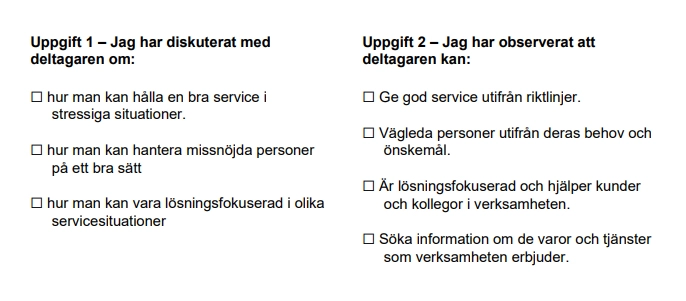
Checklist for “Providing service to others”.
Challenges and successes
One major challenge that Folkuniversitetet faces is the cost of the licence for the digital system used in the validation process. This is why they need clients such as municipalities or the Swedish Public Employment Service.
Another issue they have had to deal with is insufficient volume, which is why it is not possible to draw any statistically significant conclusions on an aggregated basis. However, Folkuniversitetet has seen the very real benefits of the work at an individual level among the assessees in the shape of increased self-confidence, new insights and the motivation to apply for employment or training opportunities.
This autumn, they have signed an agreement with the Swedish Public Employment Service to validate a larger number of people, and they look forward to monitoring the results going forward.
This article is from the NLL report: Gör alla kompetenser Synliga!
Read the original article in Swedish here.