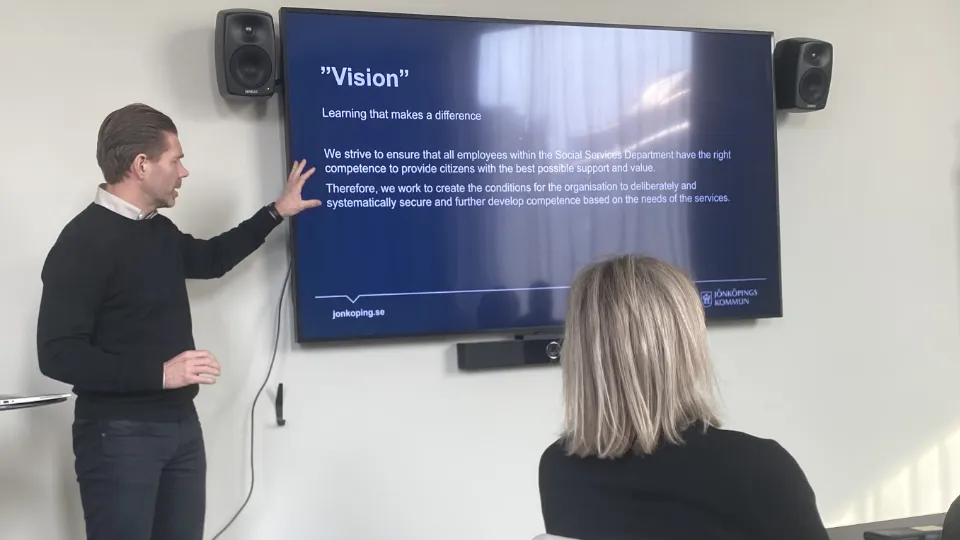

Jönköping is one of the municipalities currently testing learning circles as a method for workplace learning, following an initiative from the Nordic Network for Lifelong Learning. Two learning circles have been established in Jönköping so far. One group consists of employees working with children and adolescents, while the other group comprises coordinators for students in internships in the health and care sector. Work on establishing a third circle is underway.
Competence development for several thousand
With five to six thousand employees in social administration, skill and competence needs and learning must be put into a system, and Sinclair briefly explains how they work.
“We have a strategy for competence development with targeted groups that conduct needs analyses. Organisational competence needs are registered before moving on to individual competence development plans with education and practice. This is then followed up, and, finally, the effect of the measures is assessed,” says Sinclair.
Everyday learning
He talks extensively about “everyday learning” and practical learning in the workplace, and is open to new ways of working. How can we create “real learning”, he asks. Two or three learning circles may seem like a drop in the ocean in a large municipality, such as Jönköping, but an open attitude to new tools and working methods bodes well. Sinclair hopes the learning circles will help develop both knowledge and the capacity for action.
“We don’t know yet whether learning circles will become a permanent method in use, but we would like to try them. It takes some time to get used to this way of working, but we’re treating it as a pilot project,” says Sinclair.
Simulating back pain and respiratory problems
In Jönköping municipality, they take practical learning to heart. They put themselves in the situation of those who need help, often elderly people with severe pain and serious illnesses. A so-called “age simulation suit” is a concrete and surprising way to learn. The suit comprises equipment that simulates back pain, severe knee pain, impaired vision due to eye disease, poor hearing or tinnitus (ringing in the ears), as well as serious respiratory problems. By putting on the simulation equipment, employees get to physically experience how patients feel. The equipment is used in training and under guidance. For many, this simulation evokes aha experiences. So this is what it’s like to be in so much pain that you can’t manage to get up from a chair on your own, or struggling to breathe is so taxing on the body. Experiencing severe tinnitus for a couple of minutes is bad enough, but how can someone endure it constantly?
One of the guiding principles within competence development for Social Administration in Jönköping is collegial reflection. By testing learning circles, they strengthen collaboration, interaction and collegial reflection.
Sustainable ways of working
NLL has set the following goals for testing learning circles:
“The goal is to investigate whether and in what way the learning circle model contributes to creating a robust learning environment in the workplace, where the perspectives of both employees and managers are taken into account. How can the model contribute to sustainable ways of working?”
Article series: Learning in working life
This article is part of a series of articles on learning circles and learning in working life. The series follows NLL’s network for learning in working life and gives an insight into how learning unfolds in practice – seen from different Nordic perspectives.