
Reskilling for everyone
When the border between Finland and Russia closed in 2022, many companies operating in eastern Finland woke up to a new reality. Trade routes and customers disappeared almost overnight, leaving industries and workers facing sudden disruption. As the region began to reposition its economy, new opportunities emerged within forest and bioeconomy, creating skilled jobs in mill operations, maintenance, automation and logistics.
Across the Nordics, rapid change in energy, industry and services is pushing demand for new skills. In Finland, where unemployment remains high, Kirsi Rasinaho of the Central Organisation of Finnish Trade Unions (SAK) highlights the inclusion challenge:
-We must focus on reskilling for everyone – especially those who are unemployed now, so they do not just end up sitting at home. That means academics and blue-collar workers alike.

How skills anticipation works
Sudden technological and geopolitical changes are almost impossible to predict. However, there are several tools and strategies for foreseeing skills demand. The Organisation for Economic Co-operation and Development (OECD) defines skills anticipation initiatives as “tools, systems or exercises that collect and analyse information on future skills needs and on the availability of those skills in the labour market”. The process typically runs through the following steps:

Denmark’s Recruitment Survey and Labour Market Balance web tool are examples of Nordic skills anticipation tools. Denmark uses the tools to monitor near-term hiring needs, helping counsellors from the job centers and jobseekers navigate occupations and regions with shortages or surpluses.
From skills anticipation to competence-matching systems
Skills anticipation produces short- and medium-term intelligence. Competence-matching systems are the next step: they are the integrated architecture of mechanisms and institutions that use that intelligence to steer education offers, guidance and hiring so gaps are prevented or reduced.
Norway combines a national competence policy with tripartite governance through The Council for Skills Policy (Kompetansepolitisk råd). The council has existed since 2022 and provides the Norwegian government with skills policy advice. The council links ministries, social partners, educational institutions and municipalities and provides analyses of future skills needs and instruments.
Education providers as co-designers with industry
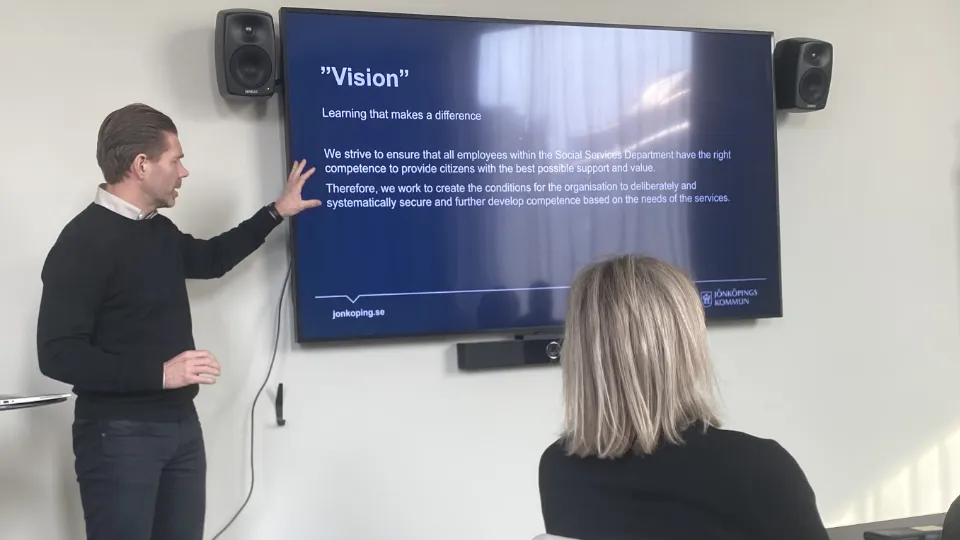
Higher Vocational Education in Sweden is built on strong and continuous involvement from working life, ensuring that programmes meet current competence needs. Marcus Karlsson, Policy Analyst (Swedish National Agency for Higher Vocational Education, MYH) explains: -Companies help design study programmes, participate on programme committees and co deliver work-based learning – enabling quick updates when needs shift. The study programme “Digital Transformation Manager in Construction and Civil Engineering”, offered at Campus Nynäshamn, is one example aligned with demand for digital and sustainability competencies in construction and urban development.
Short courses to close skill gaps
In Denmark, Akademikerne – The Danish Confederation of Professional Associations (AC) worked with two municipalities and local companies to co-design a short ESG upskilling course targeted at unemployed academics. The model was deliberately task-based rather than title-based: participants completed five to six weeks of targeted training followed by around four weeks in a company, working on concrete assignments such as ESG data collection and documentation for reporting.
Käthe Munk Ryom, International chief adviser at Akademikerne, explains:
-They designed a six-week ‘green backpack’, combined with about four weeks in a company to solve concrete tasks like ESG documentation. Over two-third of the participants found employment afterwards – not necessarily in the placement company, but because of the skills, they gained on the course.
What is the Green Academy?
The Green Academy (Det Grønne Akademi) is a 9-week, company-oriented programme that upskills participants to work as green change agents, covering circular business models, CO₂ and energy accounting, resource optimisation, the UN Sustainable Development Goals, ESG and sustainable business understanding.
It combines five weeks of training with four weeks of company placement, where small teams of 2–3 participants are paired with a host company.
During the placement, participants map and assess the company’s sustainability potential and deliver an action plan for implementing green initiatives.
The course is offered in Aarhus and Aalborg municipalities in Denmark.
About the Future Skills – Bridging the Competence Gap project
The article is part of our series on the skills gap and skills development in the Nordic region, titled Future Skills.
Future Skills – Bridging the Competence Gap (2025–2027) is a project organised as a Nordic tripartite dialogue. The Advisory Board secures Nordic relevance, scopes the work, quality-assures analysis and anchors findings in national and regional realities.
The main purpose of the project is to strengthen the Nordic countries’ ability to anticipate and match future competence needs by producing a comparative analysis of competence‑matching systems and enabling knowledge‑sharing on skills forecasting.